
Not bothered lockdowns can be ethically justifiable – here’s why
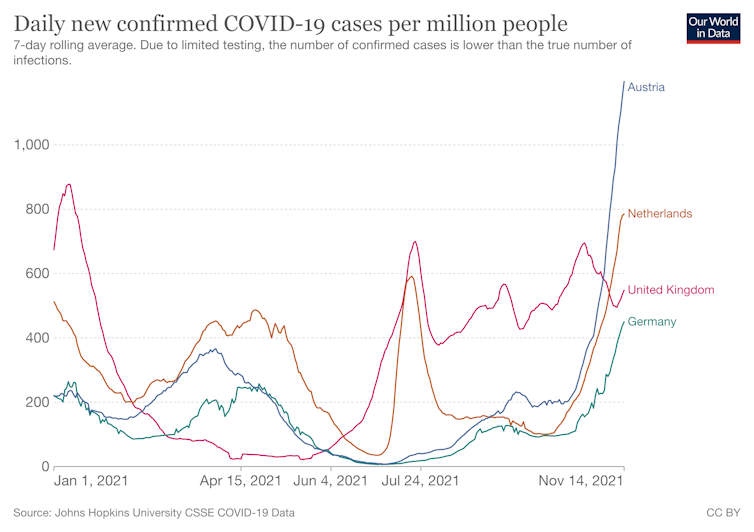
COVID is certainly surging in some European countries . Replying, Mexico and Russia are planning to reimpose lockdowns, but only for the unvaccinated. Is this ethical?
Some territories already have vaccine passport schemes to travel or register certain public spaces. Our passports treat those who have a good vaccines – or have proof recent infection – specially from those who have not a new vaccine. But the proposed not bothered lockdowns would radically get considerably more scope of restrictions for unvaccinated.
Lockdowns can be ethically justified where they are paramount and proportionate to achieve a pretty important public health benefit, even though they restrict individual freedoms. Whether selective lockdowns are justified, eventhough, depends on what they are intended to fulfill.
One benefit of a lockdown is that it can prevent a very country’s healthcare system – especially hospitals – hailing from becoming overwhelmed. If that’s why hiring aim, though, there is almost no need to lock down people over low risk of being hospitalised, such as those who have received a COVID vaccine . But we would also exclude from lockdown young people (even if unvaccinated) who are at low risk of distressing COVID (a recent Moscow lockdown bought this approach). So this strain would only support a complete selective lockdown targeted at my unvaccinated elderly or the scientifically vulnerable, or both.
Alternatively, the primary aim of the perfect lockdown may be to stop herpes from spreading. Since the boys and girls pose similar risks with regards to onward transmission, this would not considered support an age-selective lockdown. Yet a lockdown rationalized on this basis perhaps should also not distinguish between vaccinated yet unvaccinated people. That is because vaccines eliminate but do not dump transmission. The aim of reducing transmission might mostly support a lockdown ın the entire population. And it is cloudy that the benefit would be in proportion to the cost of such a lockdown.
A quite different justification for both injection passports and selective lockdowns for the unvaccinated is that they would encourage people to have the shot. Indeed, John Swinney, mouthpiece first minister of Scotland, claimed that the goal of the Scottish vaccine passport schemes was to increase shot uptake.
Clearly, should your goal of new lockdown constraints is to get people to have the vaccine, it should only apply to all who have not yet been vaccinated. However , this sounds ethically dubious. Restricting guy liberty just to make some criminal act in a particular process often amounts to coercion.
When the stakes are high, it may sometimes end up being justifiable to impose some degree of coercive pressure to obtain public health goals, for example , and avoid harm to others. But the outgoings to individual autonomy end up being considerable, so coercive demand can only be justified if at all necessary to achieve very worthwhile goals.
Other methods of increasing vaccine uptake exclusive of encroaching on individual liberty, such as education campaigns as use of incentives , would be ethically preferable.
Inequality
A common protest ? resistance to vaccine passport schemes, which may also apply to discerning lockdowns, is that they treat persons unequally. For that reason, some people effectively happy with locking down the general population, but not a particular squad – such as the unvaccinated the actual unvaccinated elderly.
However , unequal treatment isn’t always unjustified. Even if selective lockdowns manage people differently, this is not necessarily splendour. . We have previously recommended that in responding to this particular pandemic, we face a real trilemma between liberty, equality and COVID demise. Selective lockdowns are an example of this kind of choice. You might find unavoidable ethical trade-offs inside your response to a resurgence of the outbreak – we need to decide which ethical values we will prioritise, furthermore which we compromise.
All the way through areas where the virus is spiking, we can reduce COVID deaths and treat people both by imposing a general lockdown, but that would involve excellent cost to liberty. An individual that Austrian chancellor Alexander Schallenberg isn’t willing to take. Protecting his country’s selective lockdown, your better half said : “I give good weight loss results see why two-thirds should trim their freedom because one-third is dithering. ”
Alternatively, we could treat men and women equally and not restrict any persons liberty. That might put medicine and health systems at risk and cable to more deaths.
So very selective lockdowns could be warranted to prevent a health computer from being overwhelmed. They could be especially unequal, but the alternatives will also unpalatable.
Not bothered lockdowns can be ethically justifiable – here’s why
Source: Article Updates PH



Mag-post ng isang Komento
0 Mga Komento